SOCIAL ISSUES
DE SANTIS
read the comments….
SPINOZA
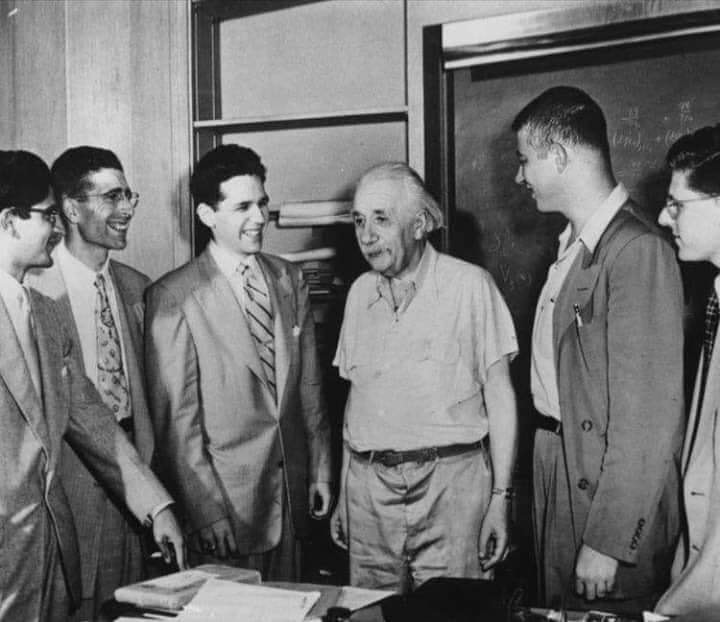
Did you know that when Einstein gave lectures at numerous universities in the US, the recurring question students asked him was:
-Do you believe in God?
-I believe in the God of Spinoza.
Whoever hadn’t read Spinoza stayed in the same ones…
I hope this little gem of history serves you as much as it does for me:
Baruch de Spinoza was a Dutch philosopher considered one of the three great rationalists of 17th century philosophy, along with the French Descartes.
Here’s a little something from him.
This is the God or Nature of Spinoza:
God would have said:
Stop praying and beating your chest!
What I want you to do is go out in the world and enjoy your life.
I want you to enjoy, to sing, to have fun and to enjoy everything I have done for you.
Stop going to those cold, dark, cold temples you built yourself and call yourself my home!
My home is in the mountains, forests, rivers, lakes, beaches. That’s where I live and I express my love for you.
Stop blaming me for your miserable life; I never told you there was anything wrong with you or that you were a sinner, or that your sexuality was a bad thing!
Sex is a gift that I have given you and with which you can express your love, your ecstasy, your joy. So don’t blame me for everything they made you believe.
Stop reading so called scriptures that have nothing to do with me. If you can’t read me in a sunrise, in a landscape, in the look of your friends, in the eyes of your son…
You won’t find me in any book!
Trust me and stop asking me. Are you gonna tell me how to do my job?
Stop being so scared of me. I don’t judge you, I don’t criticize you, I do not get angry, I do not upset, I do not punish you. I am pure love.
Stop asking me for forgiveness, there is nothing to forgive. If I ever made you… I filled you with passions, limitations, pleasures, feelings, needs, incoherents… of free will how can I blame you if you respond to something I put on you?. How can I punish you for being who you are, if I’m the one who made you? Do you think I could create a place to burn all my misbehaving children, for the rest of eternity?.
What kind of god can do that?
Forget any kind of commandments, any kind of laws; those are ploys to manipulate you, to control you, that only create guilt in you.
Respect your fellow men and don’t do what you don’t want done to yourself. All I ask is that you pay attention to your life, that your alert state be your guide.
My beloved, this life is not a test, not a stepping stone, not a step on the road, not a rehearsal, not a prelude to paradise. This life is the only thing here and now and the only thing you need.
I have made you absolutely free, there are no awards or punishments, no sins or virtues, no one carries a marker, no one holds a record.
You are absolutely free to create in your life a heaven or a hell.
I couldn’t tell you if there’s anything after this life, but I can give you one piece of advice. Live as if there is no. As if this is your only chance to enjoy, to love, to exist.
So, if there is nothing, then you will have enjoyed the opportunity I gave you. And if there is, rest assured I’m not gonna ask you if you were good or bad, I’m gonna ask Did you like it? Did you have fun ? What did you enjoy the most? What did you learn?…
Stop believing in me; believing is assuming, guessing, imagining. I don’t want you to believe in me, I want you to feel me in you. I want you to feel me in you when you kiss your lover, when you tuck your daughter, when you caress your dog, when you bathe in the sea.
Stop praising me, what kind of egolating God do you think I am?.
Tired of being praised, sick of being thanked. Do you feel grateful? Prove it by taking care of yourself, your health, your relationships, the world. Are you feeling watched, overwhelmed?… Express your joy! That’s the way you praise me.
Stop complicating things and repeating like a parrot what you were taught about me.
The only thing certain is that you’re here, that you’re alive, that this world is full of wonders.
What do you need more miracles for? Why so many explanations ??????
Don’t look for me outside, you won’t find me. Look for me inside… there i am, beating on you.
Spinoza.
AFFIRMATIVE ACTION
The Sad Death of Affirmative Action
It’s clear that what’s at stake isn’t a vision of social and racial justice that would ameliorate inequalities for a broad swath of people but, rather, a fight for spots in the élite ranks of society.
By Jay Caspian Kang
Of all the questions that were batted about during Monday’s Supreme Court arguments on affirmative action, the only one that seemed to get to the heart of the matter was asked, repeatedly, by Justice Clarence Thomas. Does diversity confer any actual educational benefits? For decades, the legal justification for considering race as a factor in college admissions has rested on the idea that students learn better, and more broadly, from being around classmates from different backgrounds, whether geographic or racial.
I do not feel the need to debate the question of whether or not diversity is meaningful to a person’s education, mostly because I think the answer is pretty self-evident and broadly accepted. The more pointed legal question—whether the benefits of diversity actually provide a compelling enough reason to practice racial preferences in admissions—is certainly more contested. But it is worth noting just how the attorneys for the University of North Carolina and Harvard argued for the benefits of diversity on their campuses. When Thomas asked Ryan Park, the solicitor general of North Carolina, his go-to question, Park talked about a study on stock trading that showed diverse stock-trading units performed better than more homogenous ones because they were more resistant to “groupthink.” Seth Waxman, the attorney for Harvard, declared a bit theatrically that the fate of the country depended on “leaders who have enjoyed wide exposure to students as diverse as the nation itself.”
All of this might be true. But it’s clear that what’s at stake isn’t a vision of social and racial justice that would ameliorate inequalities for a broad swath of people but, rather, a fight for spots in the élite ranks of society. We want diverse stock traders, corporate-boardroom members, and tenured professors. While it’s important to have diversity in any space, I think it’s crucial to clearly detail what, exactly, Harvard is making the case for. The university is arguing that it has to use racial preferences in admissions in order to maintain a helpful amount of diversity on campus. It’s also, by extension, defending its entire admissions policy, which includes seemingly looser standards for athletes, donors, and legacy admits.
Harvard’s logic is based entirely on what is allowed by law, which is that race can only be used in a “narrowly tailored” way. The definition of this term has changed, but in Grutter v. Bollinger, the Court said schools must engage in “serious, good faith consideration of workable race-neutral alternatives that will achieve the diversity the university seeks.” To prove this, schools like Harvard are supposed to show that there aren’t reasonable other ways to create diversity that do not consider an applicant’s race, such as socioeconomic affirmative action or implementing something similar to the University of Texas’s system, which admits the top ten per cent of students at any school in the state.
This line of inquiry set up a layup for the plaintiffs, which Cameron Norris, one of the attorneys for Students for Fair Admissions—the conservative legal organization fighting to end affirmative action—gladly took in his address on Monday. Norris argued that Harvard, in fact, is not diverse in any way other than racially. This, ultimately, is true not only in the Ivy League but at all sorts of exclusive colleges that typically practice racial preferences in admissions. A good thing to remember here is that the majority of college students in America attend schools that accept the overwhelming majority of their applicants, making the question of racial preferences mostly moot. For example, Harvard’s Black population is around fifteen per cent of the student body. By comparison, twenty-two per cent of the students at Bunker Hill Community College in Boston are Black. Harvard practices affirmative action. Bunker Hill accepts all of its applicants, and so has no need or ability to balance their classes based on high-minded ideas about diversity.
The diversity that Harvard promotes, by the very fact that it has to be within Harvard’s institutions, will be for wealthy high achievers, the majority of whom have led immensely privileged lives. The following numbers cannot be repeated enough: two-thirds of Harvard students come from families in the top twenty per cent of income earners. A full three per cent of students come from the top 0.1 per cent, compared with 4.5 per cent from the bottom twenty per cent. And bias toward wealthy students extends across all racial categories. An article for the Harvard Crimson’s magazine, published in 2020, looked at the relative underrepresentation of students who identify as “Generational African American” (G.A.A.), compared with the children of more recent immigrants from Africa. “If we were to count the number of GAA students at Harvard who were descended from enslaved people, came from low income backgrounds, first generation, four grandparents descended from enslaved people, I feel like that number would be so low,” one of those students said. “Like, maybe one person. It’s just so, so, so low.”
So what happens at élite schools after the Court’s eventual ruling? One bit of history that has been cited in the past few weeks is what happened in the University of California system in the late nineties after the passage of Proposition 209, which effectively banned affirmative action in the state. Between 1995, the year before Prop. 209 passed, and 1998, the Black and Latino populations at U.C.L.A. were effectively cut in half to 3.4 and 10.5 per cent, respectively. Today, after a quarter century, and half a billion dollars in interventions to boost diversity numbers without explicitly using race as an admissions criteria, those numbers have gone back up to about what they were before the passage of the law.
Today, the élite schools that practice affirmative action are much better equipped to deal with the Court’s potential decision, in part because they have had to perpetually adjust their admissions practices as the court has narrowed the scope of what is permissible through successive rulings since Regents of the University of California v. Bakke—the case that began the affirmative-action legal fight. Admissions offices now specialize in a byzantine and confusing language aimed at satisfying the Court’s mandates on just how much they can consider race.
They also seem to have been preparing for the inevitability of the Court’s decision on affirmative action.
The decision to stop requiring the SAT or ACT, which was taken up by nearly every élite college in the country, most likely did not come out of some sudden collective epiphany about the harms of standardized testing. Rather, I’d imagine that those scores could be the potential evidentiary basis for lawsuits that compared admissions rates between applicants of different races. It’s far easier to explain gaps in grade-point average, extracurricular activities, and the like than it is to explain why someone who got a 1590 didn’t get in, but someone who got a 1350 did.
“What colleges and universities will need to do after affirmative action is eliminated is find ways to achieve diversity that can’t be documented as violating the Constitution,” Erwin Chemerinsky, the dean of the University of California, Berkeley, School of Law, told me. “So they can’t have any explicit use of race. They have to make sure that their admissions statistics don’t reveal any use of race. But they can use proxies for race.”
These solutions won’t coalesce overnight. Chemerinsky predicts that the decision will be a shock to many school’s systems, and may drive down the racial-diversity numbers at a number of schools in the short term. But he also believes that many schools will find alternatives in the way that the University of California system did. “It will take concerted effort,” Chemerinsky said. “That’s what the experience in California shows—it took a great deal of trial and error.”
The real tragedy here is that the most consequential ruling on affirmative action had to come out of the Harvard case, given that there’s so little to admire or even defend about the most exclusive and élite institution of higher education in the U.S., perhaps even the world.
In one of the most embarrassing parts of the trial, Justice Samuel Alito asked Waxman the question that has been on the minds of many Asian Americans since this trial began: Did Harvard’s “personal rating” system, on which Asian applicants consistently scored lower than others, constitute an insidious way to keep Asian student numbers low, or did Harvard actually believe that Asian students lacked courage and curiosity? Waxman avoided answering the question, and continued to deflect when Alito pointed out the evasion and asked the question again. Eventually, the Justices simply gave up on getting an answer. I do not think any equity-minded educator or politician would have simply shrugged at the clear racial disparity, nor do I believe that most progressives would accept Waxman’s or Harvard’s circuitous non-answer.
The vast majority of Americans, I imagine, also believe there is value in meeting people from all walks of life and learning from other experiences. But few would argue that the ideal setting for that is a place where there are almost as many kids from the top 0.1 per cent of income earners as the bottom twenty per cent. The defenders of affirmative action, then, are placed in a nearly impossible position, one that will almost certainly end up being for naught when a 6–3 conservative majority ultimately rules in these two cases.
A broad, wide-ranging decision on affirmative action will have effects that span well beyond the admissions practices of exclusive schools. A mandate that no institution or organization that receives funding from the federal government can consider race in any of their decision-making will effectively end all types of racial remediations and interventions, whether around voting laws, financing, or housing. These are not areas where a small group of well-intentioned, hardworking admissions officers and university administrators can still work to produce the outcomes they desire. Affirmative action has been the foundation for upward mobility for women and minority groups for the past several decades. It deserves a more dignified and robust defense than what Harvard could possibly offer. 
66
 datruthchronicles
You must be logged in to post a comment.